Showing posts with label commercial fishing. Show all posts

Saturday, November 15, 2008

Bug Collection

That's right... Mickey has a growing bug collection in the freezer.


Below is photo of lobsters crawling around our patio. These lobsters are spiny lobsters caught in commercial fishing traps at the Channel Islands. Mickey got them from some commercial fishermen in Oxnard. It is a good year for lobster fishermen.


Lobsters in PatioLobsters in the Patio


Mickey and his friend, Randy, are sorting which lobsters to put in the freezer and which lobsters to cook tonight. Randy (photo below) holds up a monster lobster that looks good enough to eat!


Mickey, Randy, and LobstersMickey, Randy, and Lobsters


Below photo is Randy putting live lobsters in the freezer.


Randy Filling the FreezerRandy Filling the Freezer


Here is a big lobster in the middle... just chillin' with his buddies.


Lobster Chillin' with the GangLobster Chillin' with the Gang

Saturday, October 11, 2008

Uni For Dinner Tonight

Jon Sears lives in Florida, but we get to spend some time with him a couple of times per year when he is operating his Sea Urchin/Sea Cucumber Dive Fishery. He has a nice Radon Boat (of course), and he dives using a hookah dive system. Whenever we are in the mood for sushi, food is fresh for the taking here!
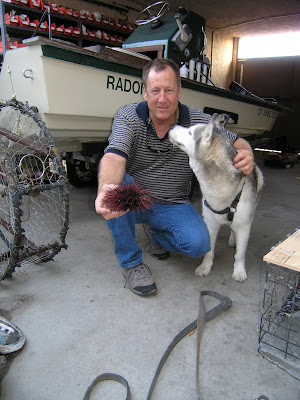

Jon Sears and UrchinJon Sears and Urchin


Tonight we're in the mood for uni, so Jon just brings a few of them home to sample.
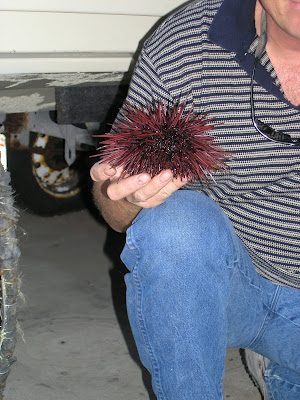

Sea Urchin in Jon's HandSea Urchin in Jon's Hand


Fun urchin facts... This animal's sharp spines spear food and protect the urchin from predators. Between the spines are hundreds of tiny, sticky, tube feet. Using their spines and teeth, urchins burrow slowly into solid rock. Because they grow as they dig, they sometimes end up trapped in holes, where they're stuck waiting for food to drift their way.
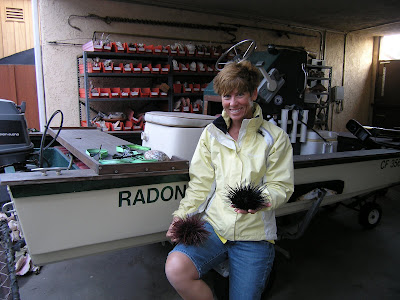

Gigi and UrchinsGigi and Urchins


The Radon Boat you see in the background is not Jon's boat. Jon's is a bit bigger, and it has a cabin.
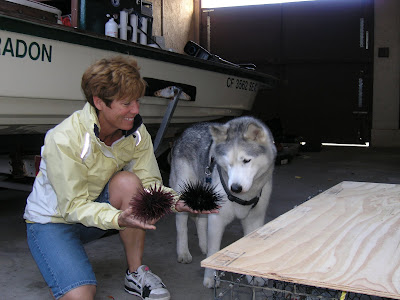

Gigi, Bonzo, and UrchinsGigi, Bonzo, and Urchins


Bonzo doesn't like uni. He would rather have chicken and rice. But, the urchins are still alive and moving, so they are interesting to watch. The urchins are still alive and moving when Jon cracks them open. How mean you are, Jon!


Jon Preparing UrchinsJon Preparing Urchins


Check out my sticky tube feet... An urchin's soft feet are always busy. Some hold the urchin to rocks, while others pass kelp and other food to its mouth. An urchin also "breathes" through its tube feet — that is where gases are exchanged, instead of in gills or lungs.


Got kelp? Urchins love to eat kelp. Sometimes they eat so much that they destroy the kelp beds. But, sea otters love to eat urchins. A healthy sea otter population prevents the number of urchins from growing too large, and helps keep the kelp forest healthy. The black stuff inside the urchin is the kelp. The orange stuff is what we eat.


Closeup of Inside UrchinCloseup of Inside Urchin

Thursday, October 9, 2008

Rejoice! Lobster Season has Opened!

Tim and LobstersTim, Two Lobsters, and Commercial Lobster Trap


Lobster season has just opened here in California, The T-ANN and other commercial lobster boats are raking in tons of beautiful lobsters like these. Tim Armstrong (shown above) is a seasoned fisherman, and he is already enjoying a good year catching these delicious bugs! The guys let me and Bonzo pose with a live lobster (see photo below). Lucky for them that Spiny Lobsters don't have the big front pinchers like the American lobsters.


Gigi, Bonzo, and LobsterGigi, Bonzo (the dog), and One Live Lobster


Other fun facts... Also known as California Spiny Lobster, Rock Lobster, Red Rock Lobster or Crayfish, and Kreef California. Spiny Lobsters are distributed all along the California coast. California Spiny lobsters live in a variety of habitats on the coast, in water from 1 foot to approximately 600 feet deep,ranging from shallow rock pools, out to the continental shelf. There is no evidence of mass migration of the California Spiny Lobster; however, movements of up to 89 miles have been reported, as well as shorter distances from inshore to deeper offshore waters. In many locations Spiny Lobsters show little movement. California Spiny Lobsters are carnivorous and eat molluscs, small crustaceans, echinoderms, and other benthic invertebrates. Major predators of both adult and juvenile California Spiny Lobsters are octopus, gummy sharks, fish such as southern rock cod, flathead, wrasse, morwong, conger eels, lingcod, and me!